SBTS Didache Reading Group

1-2013-05-02 - didache 5 week sbts

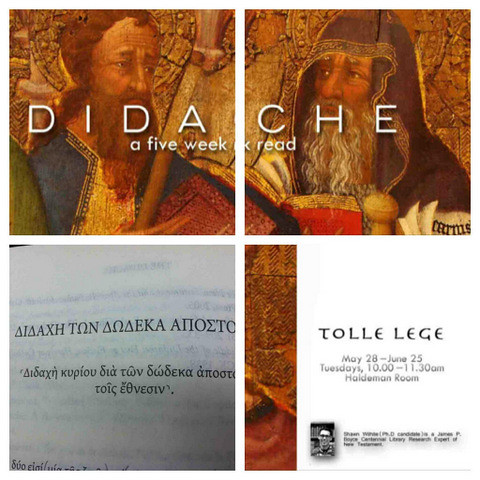
SBTS Library Research Expert[1], Shawn Wilhite[2], has put together a 5-week reading group to go through the Greek text of the Didache.[3] The Didache is not an overly difficult book to read and Shawn will provide an overview of the Didache and some vocabulary help. I am extremely excited to see the library doing this and I hope they continue it in the future.

Dates: May 28-June 25, Tusdays 10:00–11:30 am (Halderman Room)

RSVP: [email protected]

Didache Reading List
Date Reference
May 28 Did. 1:1–2:7
June 04 Did. 3:1–5:2
June 11 Did. 6:1–9:5
June 18 Did. 10:1–13:7
June 25 Did. 14:1–16:8


  1. @BoyceLibExperts  ↩

  2. @shawnwilhite  ↩

  3. Check out this helpful blog series on the Didache by Rick Brannan  ↩

Info

My Upcoming Semester

The winter break is finally over and it is time to begin the next semester. It is hard to believe that this will be my 4th semester at SBTS. I will be taking the following classes:

  1. Patristic Latin (Dr. Haykin): I am looking forward to this class for multiple reasons. As I continue in my studies I hope to integrate more of the Church Father’s writings in my exegesis. They provide a sea of valuable theological insights into scripture that we look over today. The book list for this class is: John Collins - A Primer of Ecclesiastical Latin and Keith Sidwell - Reading Medieval Latin.
  2. Greek Exegesis of James (Dr. Plummer): I just took Greek Exegesis of Matthew with Dr. Pennington and James has much overlap with the Sermon on the Mount and the sayings of Jesus. It will be interesting to study how James integrates Jesus’ teaching in his own wisdom writing. I am also interested in seeing James’ idea of spiritual wholeness or “τέλειος”. I have blogged briefly on this idea (here and here) and am contemplating on writing my paper on some aspect of this theme in James. If any of you have any thoughts or ideas on this subject, let me know either in the comments or email. For those interested I have also put together a vocabulary PDF for James. It has the vocabulary broken down by paragraph, chapter, and also a cumulative list. We will be using Doug Moo’s commentary on James and the new exegetical guide to James by Chris Vlachos. In preparation for the class I also read Richard Bauckham’s book on James, which I highly recommend for anyone studying James. I also picked up a discourse analysis commentary on James by William Varner. I hope to learn some about this topic while going through James this semester.
  3. Christian Preaching (Dr. Prince): This class in association with the 9Marks conference. Book list for this class consist of R. Albert Mohler - He is not Silent, Peter Adam - Speaking God’s Words, and Dennis Johnson - Him We Proclaim
  4. Church History II (Dr. Haykin): I have heard great things about Dr. Haykin’s teaching here on campus. This will be my first semester under his teaching and I am looking forward to learning from him. We are using a variety of books but the bulk of the reading comes from Introduction to the History of Christianity
  5. Greek Exegesis of Mark (audit) (Dr. Vickers): I will be auditing this class since I am already in one exegesis class along with my first semester of Latin. I look forward to sitting through this class and doing some of the work (just not the exegetical paper) and seeing the different theological emphasis between Mark and Matthew. The book list for this class is R.T. France’s commentary on Mark and Jonathan Pennington’s new book on the Gospels, Reading the Gospels Wisely, which I highly recommend as a wonderful introduction on reading the Gospels as Holy Scripture.

This semester should be an excellent one. Throughout the semester most of my blogging will probably be through James and Mark. I am hoping to read some of the early Church’s writing on each of these books so I will also include some thoughts on their interpretations as I read them.

Info

A Shepherd and His Greek New Testament

As an aspiring student of the original languages of the Bible I always find stories and quotes of theologians who have studied the biblical languages before us encouraging (and sometimes disheartening!). It seems that in today’s age with all the various resources and avenues of learning students should be learning the languages at an exponential rate. Sadly, the exact opposite is the case. In the preface of the 3rd edition to his Grammar of the Greek New Testament in Light of Historical Research, AT Robertson says, “The Greek New Testament is the New Testament, all else is translation.”[1] He then goes on to tell the story of a young shepherd boy who taught himself Greek without the aid of a grammar. Let this be an encouragement to all of us, if a young shepherd can have the diligence and patience to learn the language of the New Testament without aid let us all make the most of our time in our studies when we have access to the best resources at our fingertips.[2]

At the age of sixteen John Brown, of Haddington, startled a bookseller by asking for a copy of the Greek Testament. He was barefooted and clad in ragged homespun clothes. He was a shepherd boy from the hills of Scotland. “What would you do with that book?” a professor scornfully asked. “I’ll try to read it,” the lad replied, and proceeded to read off a passage in the Gospel of John. He went off in triumph with the coveted prize, but the story spread that he was a wizard and had learned Greek by the black art. He was actually arraigned for witchcraft, but in 1746 the elders and deacons at Abernethy gave him a vote of acquittal, though the minister would not sign it. His letter of defence, Sir W. Robertson Nicoll says (The British Weekly, Oct. 3, 1918), “deserves to be reckoned among the memorable letters of the world.” John Brown became a divinity student and finally professor of divinity. In the chapel at Mansfield College, Oxford, Brown’s figure ranks with those of Doddridge, Fry, Chalmers, Vinet, Schleiermacher. He had taught himself Greek while herding his sheep, and he did it without a grammar. Surely young John Brown of Haddington should forever put to shame those theological students and busy pastors who neglect the Greek Testament, though teacher, grammar, lexicon are at their disposal.

  1. Robertson, A. T. A Grammar of Greek New Testament in the Light of Historical Research. Modern. B&H Academic, 1947, xix  ↩

  2. For example Robertson’s grammar can be found for free in PDF form. Though it may be slightly out of date it is still used for its insights. In Robertson’s day it was seen as an extremely valuable book but it came with a price.  ↩

Info